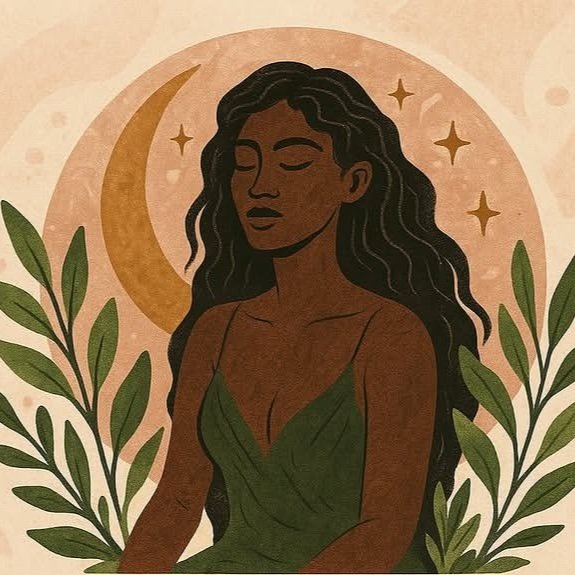
Hecate’s Garden: The Goddess of the Green Crossroads
The goddess Hecate stands at the threshold between worlds—guardian of doorways, sentry at the crossroads, mistress of the liminal spaces. In that role she is intimately connected with plants and herbal wisdom: not only the plants that heal, but the plants that transform, protect, and guide through change. By exploring herb allies historically associated with her—such as mugwort, garlic, and yew—we can enter into a living “garden of thresholds” resonant with her power and symbolism.
Who is Hecate?
Hecate is a multifaceted deity in ancient Greek religion, associated with magic, witches, night, the moon, and especially boundaries and transitions. She is often called the “Keeper of the Crossroads,” because she presides where paths meet—between life and death, mortal and divine, known and unknown.
Her role in plant‑lore is also attested: “She was variously associated … with knowledge of herbs and poisonous plants.”
Thus, when we imagine Hecate’s garden we are not simply thinking of a flowerbed, but a symbolic and sacred terrain of transformation.
The Green Crossroads: Three Signature Plant Allies
Below are three plants strongly associated with Hecate’s domain—each with both historical/folk context and modern symbolic or healing resonance.
1. Mugwort (Artemisia vulgaris)
Historical / mythological connection:
Mugwort is cited in modern herbal‑magic writings as “one of the most potent herbs used in dream magick,” and is associated with Hecate’s domain of divination and liminality.
A herbal‑folk source describes mugwort as “sacred to the goddess Artemis … and Hecate, patron of herbalists and midwives.”
Modern healing & symbolic uses:
Mugwort is used for dream‑work, to promote vivid or prophetic dreaming, and to access the unconscious or liminal states.
Symbolically, it stands for crossing thresholds of consciousness—bridging waking and dreaming, life and death, surface and depth.
Ways to work with it:
Grow mugwort near the edge of a garden or along a path (honoring Hecate’s path‑space).
Use a sachet of dried mugwort under the pillow when you wish to seek insight or work with dreams.
Burn mugwort as incense at dusk to mark a transition ritual: e.g., moving from one phase of your life to another.
2. Garlic (Allium sativum)
Historical / mythological connection:
In an article on Hecate’s herbs, garlic is explicitly mentioned: “It is likely no accident that Hecate … was offered garlic in the form of a wreath … at crossroads.”
Another source notes garlic’s long usage in protection, purification and warding—key aspects of Hecate’s guardianship of gates and thresholds.
Modern healing & symbolic uses:
Garlic is valued in folk herbalism for immune support, purification and as a protective herb—both physically and symbolically.
Symbolically, garlic marks the boundary between inside and outside, safe and unsafe—mirroring Hecate’s protective gate‑keeping role.
Ways to work with it:
Plant garlic near the entrance of your home or garden as a symbolic and practical guardian herb.
During a ritual to honour Hecate, include cloves of garlic as offerings at a crossroads (literal or symbolic) or at dusk.
Use garlic in mindful cooking with intention: “This food borders my body; may it also be my protection.”
3. Yew (Taxus baccata / other Taxus spp.)
Historical / mythological connection:
One source states: “Greeks held the yew to be sacred to Hecate… Her attendants draped wreaths of yew around the necks of black bulls … in her honour.”
Another herbal‑folk piece: “The yew has strong associations with death as well as rebirth.”
Modern healing & symbolic uses:
While yew is more symbolically than medicinally used (because of its toxicity), it stands for deep transformation, endings which lead to beginnings, and the evergreen presence of the soul beyond the mortal.
In a garden of thresholds, the yew becomes the tree of the crossing—reminding us that to live wholly we must learn to die to old forms.
Ways to work with it:
If safe and available, place a yew branch or symbolic reference (on your altar) representing the deep cycles of transformation.
At dusk or under the moon, stand or meditate beneath a yew or picture one: reflect on what in your life is ending and what new form is emerging.
Integrate a “gate” in your garden (a stone or marker) at the base of a yew or near a yew‑symbolic plant: a place of transition and honouring Hecate’s presence.
Cultivating the Garden & Practice
Here’s how to bring this concept into your own space:
Designate a sacred edge: Choose a border, path, or “crossroads” in your garden where the wild meets the cultivated, or where you sit between worlds.
Plant mindfully: Place mugwort, garlic, and a yew (or symbolic evergreen) in ways that feel meaningful to you. For example, garlic at the front gate, mugwort along the path, evergreen at the “gate” of the garden.
Time your practice: Hecate is strongly linked with dusk, the dark moon, and the time of crossroads. Incorporate ritual or reflection at these times.
Herb‑ally rituals:
Use mugwort to open vision and dreams.
Use garlic to protect and boundary‑set.
Use yew symbolism to mark the deep turning points and endings.
Offerings & invocation: Light a torch or candle (symbolic), leave offerings (garlic, herbs, incense) and speak to Hecate, inviting her guidance in your thresholds.
Reflect & journal: Ask: What threshold am I at? What am I leaving behind? What am I stepping toward? Use the garden as a mirror of inner work.
By attending to Hecate’s garden—her herbs, her thresholds, her torch‑lit paths—we invite a richer, more living relationship with the cycles of transformation. Mugwort, garlic, and yew are not just plants. They are doorways. They are teachers. They are allies in the sacred work of crossing from what was → what will be. In planting them, honouring them, working with them, we honour Hecate herself: guardian of the green crossroads.
References
Covenant of Hekate Members. (n.d.). Herbs & Plants of Hekate. Retrieved from https://www.hekatecovenant.com/herbsandplants
Herbs for Hekate – 30+ Plants for Offerings, Magick, & Connection. (2023, August 15). Backyard Banshee. Retrieved from https://backyardbanshee.com/witchcraft/herbs-for-hekate/
Moonfall Metaphysical. (2023, February 27). Herbs and Crystals Associated with the Goddess of Witchcraft. Retrieved from https://www.moonfallmetaphysical.com/s/stories/hecate-goddess-of-witchcraft
Enchanted Realm. (n.d.). Hecate – The Greek Goddess of Witchcraft. Retrieved from https://www.enchantedrealm.ca/deities/hecate
PrairieFireHerbal. (2020, August 17). Mugwort – Notes from a Coven Presentation. Retrieved from https://www.prairiefireherbal.com/blog-1/mugwort
Wicca Now. (2024, January 26). Invoking Goddess Hecate – Sacred Hecate Offerings. Retrieved from https://wiccanow.com/sacred-hecate-offerings/
Hekate’s Circle. (n.d.). Hekate’s Guises. Retrieved from https://hekatescircle.wordpress.com/hekates-guises/